
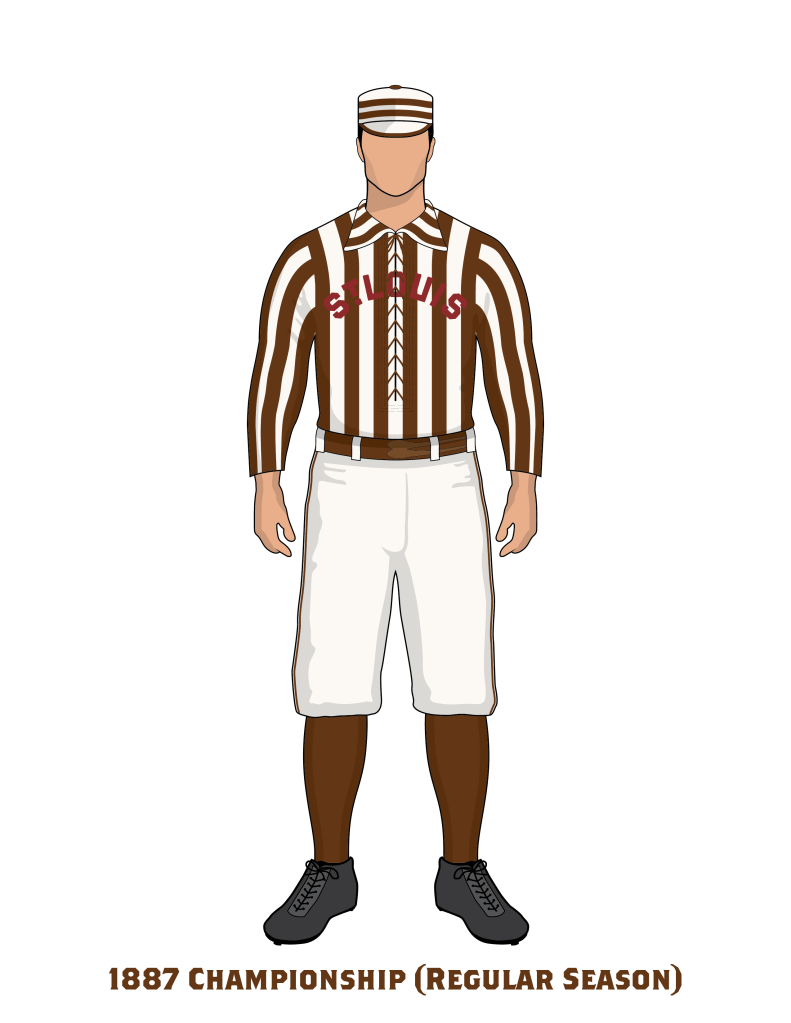
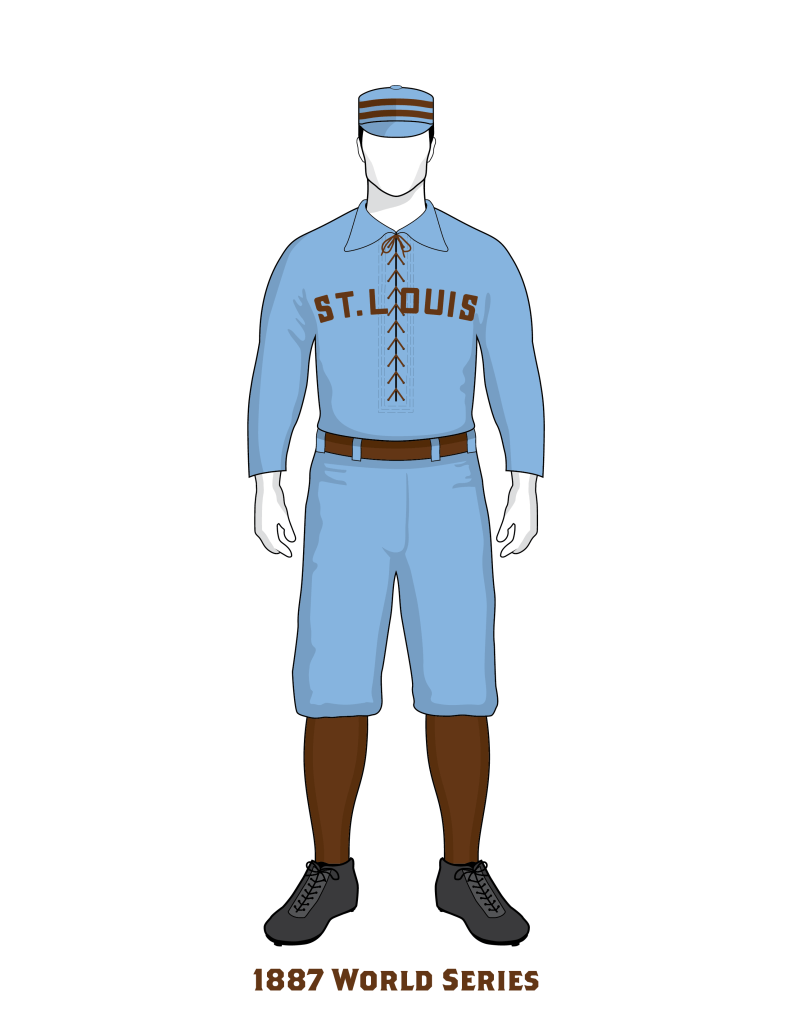
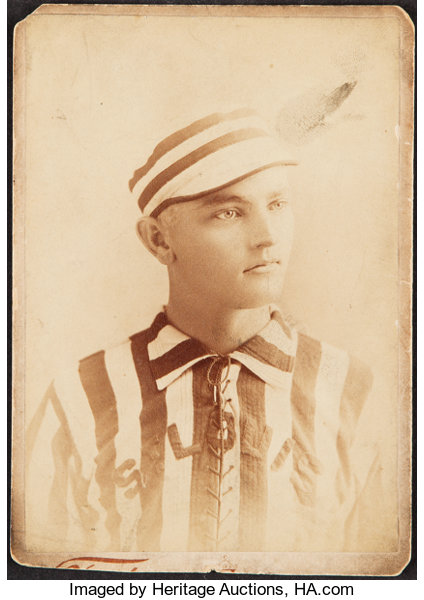
In 1887 the Browns wore four uniforms, all radically different from each other. The primary uniforms had vertical brown referee style stripes. The “exhibition kit” uniforms were likely a dark blue with maroon lettering on the chest. The alternate uniform appears in baseball cards from the era showing maroon or red shirts, but we believe it was more of a brown color than maroon. And the World Series uniforms were a light blue or a sky blue with St. Louis lettering on the chest.
In the newspaper accounts that can be read below, they refer to the Championship Season. This initially confused us, but further investigation shows they are referring to the regular season, and not any type of Postseason, Championship Series, nor World Series.
Regarding colors of these uniforms. While we are confident in some of our color choices to depict these uniforms, we are relying on newspaper accounts that often times use different words to describe the same color, and sometimes even contradictory to each other. All colors have been approximated.





Newspaper Accounts
The Sporting Life: February, 1887
The St. Louis Browns’ uniforms will be of a rich shade of brown-striped imported cloth, and will exceed in color, finish and durability any uniforms ever used by St. Louis clubs.
St. Louis Globe Democrat: February 18, 1887
From the New York Sun — While most base-ball club managers are dickering for the man who can play the best ball, the manager of the Detroit team says he is determined to have the finest uniform in the League. “The pants,” as we learn through our esteemed cotemporary, the GLOBE-DEMOCRAT, “will be of English cricket flannel of indigo-blue color,” and the team will wear tourist blouses, which are expected to give the costume “a jaunty appearance that will be decidedly attractive.” The subject should not be neglected by any manager who wishes to be distinguished in his profession. The uniforms are really an important element in the enjoyment of baseball games. To see a lot of young men neatly dressed with fresh-looking garments of harmonious colors is immeasurably more attractive than to see the same party dressed in crudely colored, badly cut and unbecoming uniforms. We think the Detroit uniform, though, will not be bad. Dark blue preserves its richness far better than light blue, which is apt to look shabby and used up. But for all uniforms white is best, and whatever color each club selects can best be limited to the stockings, if knickerbockers are worn, and to some slight trimmings of the shirt. But an important thing which managers sometimes go wrong on is the hat. The worst hat that we recollect seeing was a flat-crowned affair that we believe used to be worn by the Chicagos. A simple roung-crowned cap is, by all odds, to be preferred to other styles, and it should be white, too, like the shirts and breeches. We also trust that all managers will carefully avoid dressing their men in close-fitting shirts. The general effect of these is to make the nine look rather “tough” than otherwise, whereas a loose shirt adds to every man’s grace, and, in conjunction with the breeches, which can not well be skin-tight, gives the costume a far more harmonious and coherent outline. Besides, with a loose shirt there is far less danger of catching cold.
(This provides proof to dark blue uniforms existing throughout the league as a trend)
Sporting Life: March 23, 1887
The Browns will have two new uniforms. The championship uniform will be of the champion’s color, brown and white striped, of the finest cloth. The relay or exhibition game uniform will be of blue — shirt and breeches — and wine colored stockings. Across the breast of the shirt words, “St. Louis Browns” will be placed in wine colored cloth. The boys of the of the boss club will be supplied with uniforms this season.
Chicago Tribune: April 8, 1887
THE CHICAGOS PLAY BALL
ST. LOUIS, MO. April 7. – [Special.] – Five thousand supporters of the home team witnessed a Waterloo at Sportsmen’s Park this afternoon, and Captain Anson was the Wellington of the occasion. The day was beautiful, but a strong wind came down from the north just before the game was called and carried fly-balls far out in the field. The betting before the game had got down to even money. The Chicago were received with applause, and the familiar blue and white uniform contrasted strongly with the plum-colored suits of the St. Louis men. Umpire Doescher called play at 3 o’clock, and the Browns went to bat.
–research from Craig Brown at http://www.threadsofourgame.com
St. Louis Post Dispatch: June 14, 1887
The color of at least one uniform of each club in the League and American Association is given below. It would be next to impossible to give the several different uniforms of each club, as they change the different pieces of one uniform to another, and may appear on the field in a different make-up every day for a week. However, one complete uniform of each club is as follows:… St. Louis — white and brown shirts and caps, white trousers; brown stockings
The Sporting Life: 1887
The St. Louis Browns donned new uniforms in the first game with the Detroits. They are blue and brown. The caps are blue with brown stripes.
The Sporting Life: 1887
Maybe those beautiful new blue uniforms were the Browns’ hoodoos?
St. Louis Post Dispatch: October 9, 1887
Last championship game to-day.
The Detroits arrive this morning.
Tie games are becoming the fashion.
The Browns got their new uniforms last night. They are a solid blue, with brown stockings.
St. Louis Globe Democrat: October 11, 1887
The appearance of the Browns was the signal for a burst of applause which amounted almost to an ovation. The home boys looked very giddy in suits of a bright blue, forming, with the brown hose, a very showy combination.
The Evening World: October 14, 1887
For several hours the players remained in their apartments, but presently they strolled down into the hotel corridors and proved the centre of attraction for many delighted eyes. The uniform of the Detroits is a black suit, with snow-white caps and stockings. The St. Louis men take their popular name from their brown stockings and the Broad stripes of brown on their blue caps.
The Cleveland Leader: October 14, 1887
The Browns new uniforms are rather striking and dressy-looking. They are bright blue with caps to match, brown stockings, and “St. Louis” in black braid across the breast.
The Sun: October 15, 1887
At 1 1/2 o’clock the two nines in full uniform. The Browns in their dark blue and brown stockings, and the Detroits in blue uniforms and white stockings, took carriages for Washington Park. All along the line of the short parade they were greeted with cheers. They were the great attraction of the day, and everywhere they turned they met with great crowds, all eager to see the great ball clubs. As the clubs passed along the several streets the men cheered by name. The better known players, such as Comiskey, Hanlon, Lantham, Dan Brouthers, and Manager Watkins came in for a large share of the attentions.
The Boston Globe: October 15, 1887
The game was called promptly at 3 o’clock, with the St. Louis Browns at the bat. Latham, in his light blue uniform with collar turned up, mopped his face and shook his bat at Conway. Ball one, ball two, ball three and ball four were called; then two strikes, and Latham hit a foul, another foul and a third. Conway gave him the fifth badly pitched ball, and he took his base. He danced around first, and at the second pitched ball ran to second. Bennet threw a little high, but Dunlap made a magnificent one-handed catch. Gleason was hit by a pitched ball and got to first. Latham ran down to third on the next pitched ball and Gleason took second. Latham got there by the skin of his teeth.
New York Times: October 16, 1887
St. Louis followed in more carriages and received more cheers and admiration. No debutant or prima donna was ever more closely inspected than were the nine in blue and brown. They were a trible gaudy as they descended with scarlet “blazers” over their bright blue uniforms, and they lounged somewhat carelessly through the plebeian throng as if they owned the earth and could not afford to bother with its petty population.
Chicago Inter Ocean: October 26, 1887, research from Dan O’Brien www.rubewaddell.net
The St. Louis team was radiant in a sky-blue suit with red jackets and brown stockings.
The San Francisco Examiner: November 21, 1887
OPENING OF THE WINTER SEASON BY THE EASTERN CLUBS.
First came the brass band, then a hack containing D. R. McNeill, President of Central Park Association, James A. Hart, manager, and C. B. Powers, the umpire. Next rode the Philadelphias, clad in white pants and shirts, red stockings and white caps ornamented with red stripes. After them came the famous St. Louis Browns, in red and white habiliments, while last rode the Chicagos, who wore suits of blue and white, with the blue almost washed out. Were it not that “Beauty unadorned is best adorned” the Chicagos would have looked a dingy crowd.
The San Francisco Examiner: November 25, 1887
There were fully 5,000 people present at the afternoon game, all eager to see the renowned “hurrah” players–the St. Louis Browns. That team was ushered on the grounds by Manager McNeill while the band played soul-stirring music. Their appearance as they leaped over the railing, clad in their blue uniforms, with brown trimmings and red over-jackets, was the signal for a grand howl from the assembled spectators.
—research from Craig Brown at threadsofourgame.com
The Sun: December 29, 1887
The Cincinnati Club’s team for the 1888 season will be uniquely uniformed. Fennely will wear a maroon shirt, with cap to match; Reilly, a shirt with blue and black stripes; McPhee’s colors will be blue and white; Carpenter’s red and white; Tebeau, orange; Corkhill, black and red; Nicoll, sky blue; Mullane, red and black, Baldwin, orange and black; Smith, white; Keenan, pearl; Viau, cardinal, and Hart, maroon. The uniform to be worn by the club away from home will be navy blue, similar to that worn by the champion Browns last season.
Team Colors
Brown – PMS 732
Browns Blue – PMS 288
Browns World Series Blue – CMYK 46/18/1/0
Off-White Fabric – CMYK: 1/2/3/0
 Cardinals Uniforms & Logos